I
was recently interviewed by acclaimed western author SCOTT HARRIS for his ‘Friday Forum’ blog, which you can find
here:
I
talk about westerns and my writing, including my novel‘The Peacemaker.’ Scott very kindly agreed to the interview
appearing on my blog also.
Questions in bold.
1. When—and why—did you first fall in love with Westerns?
As a kid
growing up in England in the 60s I fell in love with westerns watching movies
and shows on TV. I was particularly taken by ‘The High Chaparral’ TV series, its Arizona location photography and
the background of the Apache Wars, which sparked a life-long interest in Native
American history and culture.
(I’ve
given a fuller appreciation of ‘The High
Chaparral’ in an earlier blog: https://andrewmcbrideauthor.blogspot.com/2017/09/in-praise-of-high-chaparral.html)
In the
70s when I was entering adulthood I had a pal who turned me on to reading
westerns, starting with the ‘McAllister’ series by MATT CHISOLM.

2. Who are your three favorite Western writers?
The first
of several impossible questions you’re going to torture me with during this
interview. I have to pick three out of the likes of Ralph Cotton, Fred Grove,
Louis L’Amour, Glendon Swarthout, Robert MacLeod, A. B. Guthrie Jnr., Lewis B.
Patten, Jack Schaefer, Dorothy M. Johnson, Charles Neider etc.? Three who I
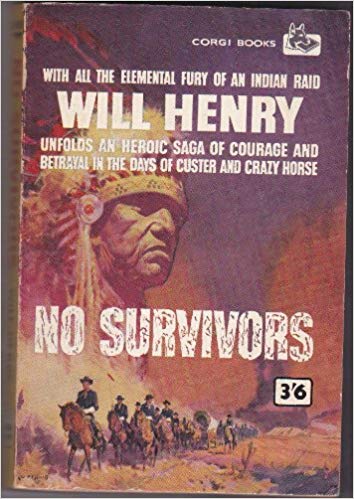
followed fairly slavishly when I was cutting my teeth on reading westerns were WILL
HENRY, GORDON SHIRREFFS and MATT CHISOLM – I devoured Chisolm’s ‘McAllister’
series, and then found out he was British, which inspired me – so let’s go with
those three.

3. Which Western do you wish you’d written?
‘Hondo’ by LOUIS L’AMOUR. In some ways
Hondo is the template western hero and I’m sure my main character in all my
westerns, Calvin Taylor, owes something to him. Once, to warm myself up for a
writing project, I re-wrote the first chapter of ‘Hondo’ and then had to stop myself from re-writing the whole novel!
I think that would be an interesting exercise for another Scott Harris-helmed
’52 weeks’ project – get us lesser mortals to follow in the footsteps of the
greats and re-write, in our own words, a chapter from a classic western
novel.

4. What is the most recent Western you’ve read?
I read a
few recently that didn’t happen for me so I’m not going to mention them. I also
re-read some old favourites. The most recent ‘new’ western I read and liked was
‘Geronimo must die’ by J.R.
Lindermuth.
(You can find ‘Geronimo must die’ here https://www.amazon.com/Geronimo-Must-Die-J-Lindermuth-ebook/dp/B06XFZJG5H/ref=tmm_kin_swatch_0?_encoding=UTF8&qid=&sr=
(You can find ‘Geronimo must die’ here https://www.amazon.com/Geronimo-Must-Die-J-Lindermuth-ebook/dp/B06XFZJG5H/ref=tmm_kin_swatch_0?_encoding=UTF8&qid=&sr=

5. The “Desert Island” question.
What are your three favorite Western books?
Impossible
to say – but as you’ve cornered me I’ll play along. ‘Little Big Man’ by THOMAS BERGER, which deals with tragic events
and yet manages to be extremely funny in places, and has subtleties the film
lacks;

‘Blood Brother’ by ELLIOTT ARNOLD, which
deals with the Apache chief Cochise and had a huge influence on my writing,
particularly ‘The Peacemaker’;

and ‘The Buffalo Soldiers’ by JOHN PREBBLE which
tackles numerous western clichés in a startling and original way. I don’t think
you’ll find a better written western. And Prebble was also a Brit!
(Read my
post about ‘The Buffalo Soldiers’: https://andrewmcbrideauthor.blogspot.com/2018/09/andrew-mcbride-on-how-buffalo-soldiers.html)
What are your three favorite Western movies?
Even more unanswerable than the ‘3 books’ question. But as John Wayne and John Ford were, IMHO, the two most important people in western movie history one would have to be a combination of their talents. Which boils down to a wrestling match between ‘Stagecoach’ and ‘Fort Apache’ – I think I’ll go for ‘Fort Apache’.

John
Wayne and Henry Fonda in ‘Fort Apache’
(1948)
‘Ride the High Country’ for its
elegiac quality and the wonderful performances of Randolph Scott and Joel
McCrea.

Randolph
Scott and Joel McCrea in ‘Ride the High
Country’ (1962)
‘Hombre’ which is based on a great ELMORE
LEONARD novel that almost made it into my ‘best 3 books’ list.

Paul
Newman in ‘Hombre’ (1967)
I’ve
posted about how ‘Hombre’ – both book
and film – influenced my writing: https://andrewmcbrideauthor.blogspot.com/2017/07/giveaway-andrew-mcbride-on-how-book-and.html
6. Of the books you’ve written, which is your favorite—and why?
6. Of the books you’ve written, which is your favorite—and why?
‘The Peacemaker.’ I like
all my first five published books, but they were of necessity short, which
meant they had to be action-centric, dependent on a fast pace. With a longer
book like ‘The Peacemaker’ I could
slow down a bit, spend more time on character and atmosphere. I got to play
around with a real historical person – in this case Cochise. I was able to
write a proper love story. I could provide what John Ford called ‘grace notes’
in his movies, quiet, reflective bits where not much happens but they give the
story added texture and depth. I was very grateful to my publishers for letting
me do that.

7. What is the most recent Western you’ve written?
The most recent western item I’ve finished is my short story ‘Spectres at the Feast’ which you were kind enough to include in your excellent ‘The Shot Rang Out’ anthology (which I review here https://andrewmcbrideauthor.blogspot.com/2018/05/my-review-of-shot-rang-out-by-scott.html )
The most recent western item I’ve finished is my short story ‘Spectres at the Feast’ which you were kind enough to include in your excellent ‘The Shot Rang Out’ anthology (which I review here https://andrewmcbrideauthor.blogspot.com/2018/05/my-review-of-shot-rang-out-by-scott.html )

8. Can you tell us anything about your next book?
I’m going through a slightly frustrating time at the moment. I have one project that won’t die! In other words it’s proving difficult to finish it off. I’m stalled on several others, waiting for responses from publishers etc. I did make a start on a new western, which has an elegiac, end-of-the-west quality and I’m keen to get stuck into it, but tidying up other projects keeps preventing me from having a clear run at it.
9. If you could go back in time, what would be the time and place in the Old West you’d like to have lived in for a year?
I’d only want to pop back for a few hours. I’m an Alamo buff, so I’d love to solve the eternal mystery of what happened there on the morning of March 6th 1836, particularly to Davy Crockett. However, if I did find myself in the middle of the final assault on the Alamo I’d like to be both invisible and invulnerable, to avoid all the bullets, cannon balls and bayonets in the neighbourhood!

10. Is there a question you’d wish I asked?
The answer?
No. Answering
questions 2 and 5 was traumatic enough!


