Showing posts with label Wyatt Earp. Show all posts

Wednesday, 16 September 2020

REVIEW of THE LILY OF THE WEST by KATHLEEN MORRIS

 Kathleen Morris started her western writing career in tremendous style, winning the Peacemaker Award for best first novel with her debut ‘THE LILY OF THE WEST.’ Here’s my 4 Star review, which you can find on Amazon.co.uk and Goodreads:

Bold new view of a familiar tale

Kathleen Morris certainly ‘hit the ground running’ as a western novelist as her debut ‘Lily of the West’ won the Peacemaker Award for best first novel. ‘Lily’ is a refreshing new take on a familiar tale. ‘Big Nose’ Kate Elder normally only features as a supporting player in the story of Wyatt Earp and John Henry – ‘Doc’ – Holliday. Here she takes centre stage and we follow her life from long before she met either of these western legends to long after. Born in Hungary, Kate travels from Europe to Mexico to Iowa, then St. Louis and New Orleans. Tragedy and chance take her west, to the dusty plains of Kansas, Texas and finally Arizona. Here tension builds as the Earp Brothers and Holliday square up against the Clanton Gang, leading to their historic clashes in Tombstone. But as much tension arises from the curious triangle of Kate, ‘Doc’ and Wyatt Earp. Kate attempts to steer ‘Doc,’ the man she loves, away from what she sees as the malign influence of Earp, but the strange bond between the two men keeps luring Holliday back. I particularly liked the touching description of Kate and Doc’s final months together, after these mighty events have passed. Recommended.   


In the rest of this blog I’m not going to explore the historical life of Kate Elder – also known as Kate Harony. Kathleen Morris does that in her novel. I thought I’d have a brief look at how she’s been depicted in film.


The real KATE ELDER/ HORONY (1850-1940)

The story of WYATT EARP and his associates (most notably ‘DOC’ HOLLIDAY) have proved perennially fascinating for western movie makers. Most focus on Earp’s tenure in Tombstone, Arizona and the events surrounding the misnamed ‘Gunfight at the OK Corral.’ In reality the gunfight took place in a vacant lot behind the O.K. Corral, next to a boarding house and photography studio, not in the corral itself.


Wyatt Earp (1848- 1929)

In the endless list of Earp-related films, perceptions have shifted. Early depictions of Earp as portrayed by veteran western movie stars like HENRY FONDA, RANDOLPH SCOTT, BURT LANCASTER and JOEL McCREA were as the ultimate western lawman, honourable, incorruptible and driven by a keen sense of justice. Few film makers would depict him so nowadays. Even the most sympathetic recent takes on him, as in ‘Tombstone’ (1993) acknowledge him as a flawed individual. Other depictions, such as ‘Doc’ (1971) show us Earp as a ruthless, corrupt, self-serving killer. All of which, fascinatingly enough, reflect views of the real man held during his lifetime, when he was a controversial figure who starkly divided opinion.
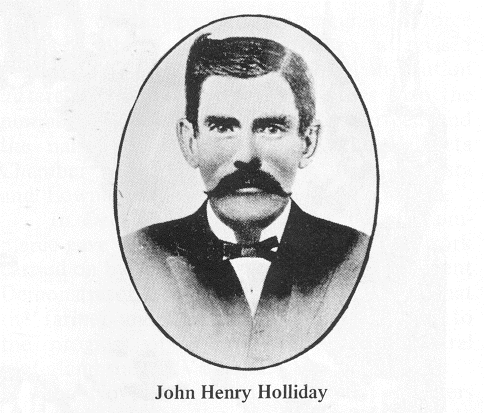


‘Doc’ JOHN HENRY HOLLIDAY (1851-1887)

My favourite Earp movie is ‘My Darling Clementine’ (1946) directed by JOHN FORD. Ford cheerfully gets all his hard facts wrong, even the year of the OK Corral gunfight! However, in ‘print the legend’ vein he creates a masterly film, beautifully made. An unlikely piece of casting is VICTOR MATURE as Holliday. No Kate Elder features in the movie, although he is associated with two women – ‘good girl’ Clementine (CATHY DOWNS) and ‘bad girl’ Chihuahua (LINDA DARNELL) who is a sort of Mexican/Apache version of Kate.


Linda Darnell

In ‘Gunfight at the OK Corral’ (1957) Holliday is portrayed by KIRK DOUGLAS. There are various contenders for best on-screen Holliday but Douglas gets my vote. His Holliday is, like most screen depictions, more or less a ‘bad guy’ who is only persuaded to join the side of law and order by his unexpected friendship with Wyatt Earp. Douglas is tremendous as a tortured and self-destructive loner who can also be charming, cynically funny and charismatic.


Kate does appear in this movie. Hollywood broke away from its usual practice to have her depicted by an unglamorous actress – the excellent JO ANN FLEET. In this movie Doc and Kate’s tempestuous relationship plays out like an Old West version of ‘
Who’s afraid of Virginia Woolf!’


Doc’ (1971) shifts the focus in having Holliday (played by STACY KEACH) as the central character. This provides a larger role for Kate, portrayed by a dowdy and bedraggled FAYE DUNAWAY in probably the most unglamorous role of her career. This film was very much one of the ‘revisionist’ westerns of the time, setting out to debunk western myths. But Stacy Keach complained that the script lost a lot of its subtlety and humour in the course of the production.


In ‘
Tombstone’ (1993) Hungarian-born Kate is finally portrayed by another Eastern European – the Polish actress JOANNA PACULA – while VAL KILMER’s performance as ‘Doc’ won acclaim.


This pair have an easier relationship than the one depicted in ‘
Wyatt Earp’ (1994) where Doc is portrayed by DENNIS QUADE. Kate is again portrayed by a European (although still not Hungarian) actress, ISABELLA ROSSELLINI.   


In the western/supernatural/horror TV series '
Wynonna Earp' (which I haven't seen) Kate, played by CHANTEL RILEY, is apparently reincarnated as a vampire!


Maybe it's time Kate was the centre of her own movie...

More reviews for THE LILY OF THE WEST

‘Superbly written.’

‘This book is filled with sumptuous language and an interesting cast of characters.’

‘Beautifully written, telling the story of a young girl, and her growing into a woman of the "wild west". If you love stories of triumph over tragedy, placed in an historical setting with an accuracy and a telling that will keep you turning each page to learn more... you will love this book.’

‘Kathleen Morris does a great job of filling in the gaps between well-known fact and probable fiction…. This great, award-winning story gives the reader a fresh and seldom told side about someone who was there as the American frontier came of age. A must-read for those whose interests include that era of American history.’

‘This is a wonderfully written book that could appeal to both women and men. I’m don’t typically read Westerns, but this book had so many great elements, that it kept my interest throughout the book.’


‘A fresh, thrilling, and insightful exploration of the often maligned or dismissed Mary Katherine Haroney as told by Kate herself.’

Find THE LILY OF THE WEST here:https://www.amazon.com/Lily-West-Kathleen-Morris-ebook/dp/B08DM4NKVC/ref=sr_1_1?crid=3FM8S5BJO8QNY&dchild=1&keywords=the+lily+of+the+west&qid=1600154374&s=books&sprefix=the+lily+of+the+west%2Cstripbooks-intl-ship%2C244&sr=1-1


Thursday, 4 April 2019

AUTHOR FAVOURITES: LAWMEN by JACK GILES


Ray Foster, who writes westerns as JACK GILES, tells me a favourite of his own novels is LAWMEN.

Ray has allowed me to say this: in 1999 he suffered a stroke – which he’s now recovered from, fortunately - and couldn’t remember the previous thirty years of his life, including his career as a western writer. LAWMEN was the first novel he attempted after his stroke, and proved he could still do it! LAWMEN, he says, 'was a challenge and I'm proud of it.’

Tom Ford, the sheriff of Stanton, has been gunned down trying to keep the peace between rival ranches. His son Chris returns home to face his past and to find his father's killer. The only way he can do that is by taking up his father's badge - only to discover that not everything is as it seems.

Lawmen who lost relatives (who were also lawmen) in the real west include WYATT EARP (1848 - 1929) who lost two brothers to violence and had a third one crippled, (I’ve blogged about Wyatt Earp’s brothers here: https://andrewmcbrideauthor.blogspot.com/2018/11/author-favourites-brothers-of-gun-by-b.html

and BAT MASTERSON (1853 - 1921) who had a brother – ED (1852 - 1878)  - shot and killed on the streets of Dodge City in 1878.


Wyatt Earp and Bat Masterson (standing) in 1876


Ed Masterson shortly before his death at the age of 25

Review of LAWMEN:


This isn't a shoot `em up western, but rather a measured consideration of character, an honest depiction of the men who didn't flinch when they had to shoulder the burden of an entire town's survival. Even the bad guys seemed to end up on the wrong side of the tracks by accident rather than by any evil notion… The gunplay, when it happens, seems real and tragic…. The writing has style and the characters, complete with humorous interplay, come alive.' 

Wednesday, 21 November 2018

AUTHOR FAVOURITES: BROTHERS OF THE GUN by B. S. DUNN (BRENT TOWNS)


Brent Towns (who also writes as B. S. Dunn, Jake Henry, and Sam Clancy) tells me a favourite of his own novels is BROTHERS OF THE GUN – credited to B. S. Dunn.

Buford Lance is a rancher who sees his hard-won New Mexico range threatened by homesteaders. To ward them off he hires two gunmen – Lucas Kane (nicknamed the Gun King) and his brother Jordan (the Prince) - but ends up setting brother against brother.

There are a number of ‘brothers of the gun’ who feature in Old West history, including the James Brothers, The Youngers and Ben and Billy Thompson. And then of course there were the Earp Brothers.

Of the six Earp Brothers only NEWTON never served in a law-enforcement position. The remaining brothers all did, and three of them paid a high price.

WYATT (born 1848) lived longest, until 1929, surviving into the age of western motion pictures, meeting JOHN FORD among others, and was available to sell himself as the most important figure of the clan. Some authorities claim, however, that Wyatt inflated his own leadership role and VIRGIL was the real brains of this outfit. It was Virgil, after all, that enemies of the clan went after first in the aftermath of the legendary ‘Gunfight at the OK Corral.’


Virgil (born 1843) served in the Union Army during the American Civil War. He worked at a variety of jobs, including peace officer, farmer, rail construction, stagecoach driver, sawmill sawyer, mailman and prospector. 
A reporter whose story was printed in the ‘San Francisco Examiner’ described Virgil in 1882: ‘His face, voice and manner were prepossessing. He is close to six feet in height, of medium build, chestnut hair, sandy mustache, light eyebrows, quiet, blue eyes and frank expression. He wore a wide-brimmed, slate-colored slouch hat, pants of a brown and white stripe, and a blue diagonal coat and vest.’
Virgil was a constable in Prescott, Arizona in 1878-79. In 1879 he served briefly as deputy U.S. marshal for the Tombstone District of Arizona. The next year Virgil was also appointed acting town marshal of Tombstone, becoming permanent city marshal in 1881. So he was the highest-ranking lawman, both deputy U.S. Marshal and Tombstone City Marshal, when he led his brothers Morgan and Wyatt, plus Doc Holliday, into the ‘Gunfight at the OK Corral’ – they were merely his deputies, appointed as temporary assistants. 
But two months after the OK Corral, on the night of December 28 1881, Virgil was ambushed on the streets of Tombstone. He was shot in the back, hit with three shotgun rounds, shattering his left arm and leaving him permanently maimed. He then left Arizona.
Despite his injuries Virgil served once more as a lawman, as city marshal in Colton, California 1887-1888.
He died from pneumonia in 1905, aged 62.
In 1875, MORGAN (born 1851) became a deputy marshal in Dodge City, Kansas. In1879-1880, he served three months as a policeman in Butte, Montana.  He joined his brothers in Tombstone in time to participate at the OK Corral.


Four months later came a reckoning.

At 10:50 p.m. on Saturday, March 18, 1882, Morgan was playing billiards in a Tombstone billiard parlour while Wyatt watched. A shot through a windowed door struck Morgan in the back, fatally wounding him. Before dying, he reportedly said, ‘This is the last game of pool I'll ever play.’

WARREN (born 1855) occasionally served as a deputy for his brothers in Tombstone. But his father reportedly said of him: 'If Warren ever dies he will be shot. He is too hasty, quick-tempered and too ready to pick a quarrel. Besides he will not let bygones be bygones, and on that account, I expect that he will meet a violent death.’


Earp Senior was proved right. In 1900 Warren was involved in a drunken argument with a local cowboy in a saloon in Wilcox, Arizona. When it came to guns, Warren was shot in the chest and killed.

JAMES (born 1841) was only briefly a lawman, serving as a deputy marshal in Dodge City in 1878-1879 and once or twice as Virgil’s deputy in Tombstone. 

This deadly fraternal clash in BROTHERS OF THE GUN reminded me of NIGHT PASSAGE, where Audie Murphy and James Stewart are the brothers pitted against each other

Audie Murphy and James Stewart in ‘Night Passage’ (1957)

or SADDLE THE WIND, where the clash is between Robert Taylor and John Cassavetes.

Robert Taylor and John Cassavetes in ‘Saddle the Wind’ (1958)


Reviews of BROTHERS OF THE GUN:

‘Awesome …A gun slinger who takes you by surprise.’

‘What an exciting book. …a gun slinger who would not just kill for the money, he actually had a heart and a code he lived by.’

‘Fast paced, action packed, solid characters… This one ticks all the boxes of what I want in a Western.’

https://www.amazon.com/Brothers-Gun-Black-Horse-Western-ebook/dp/B01N9RHM4H/ref=tmm_kin_swatch_0?_encoding=UTF8&qid=1493648994&sr=1-1 and https://www.amazon.co.uk/Brothers-Gun-Black-Horse-Western-ebook/dp/B01N9RHM4H/ref=sr_1_1?s=books&ie=UTF8&qid=1542366900&sr=1-1&keywords=brothers+of+the+gun+b.+s.+dunn

Thursday, 8 June 2017

DEATH WEARS A STAR by ANDREW McBRIDE


Up until April 2017 I had 2 acclaimed western novels, THE PEACEMAKER – published by Sundown Press as a paperback and e.book – and SHADOW MAN published by Crowood Press as an e.book – available to buy.
Reviews of THE PEACEMAKER:
‘A great book’ Spur award-winning and Pulitzer Prize-nominated author ROBERT VAUGHAN
For pure writing style, McBride’s gritty prose nails the time and place of his story with bold authority. …this relatively new author has thoroughly, and rightly so, claimed his place among the top Old West storytellers.’ RALPH COTTON (also a Pulitzer-Prize nominated novelist.)
SHADOW MAN: ‘A little masterpiece waiting for you to turn the page.’
Well, now there’s 4 more!  My 4 other western novels, originally published as hardbacks and paperbacks, have now been re-issued as e.books by Crowood Press. They are CANYON OF THE DEAD, DEATH WEARS A STAR, DEATH SONG and THE ARIZONA KID. They too have received acclaim. I’ll be blogging about them separately over the coming weeks.
Today I discuss DEATH WEARS A STAR, which was the second of my westerns to be published.

We authors often admire our early work for its freshness and energy even if we’re still working out how to do the job properly – a bit like having affection for your young, if sometimes foolish, self.
I have the same affection for DEATH WEARS A STAR, although – and this might be a more honest confession than you often hear from authors – I wouldn’t rate it as a favourite. Reading it now, I think its weakness is there’s too much plot – I was too ambitious in tackling a quite complicated set-up in a short book. I compounded that by making a proof-reading error – a paragraph or so in Chapter 8, giving an important piece of information you really need to understand the story was left out. Overall, it’s probably too busy, there’s too much going on, and the pace is too breathless. Having said that I’m still proud of DEATH WEARS A STAR and think it’s a highly enjoyable read.
DEATH WEARS A STAR BLURB:
The Tengen brothers planned to make themselves all the law there was in Coffin Creek and the surrounding Cochise Country. Then the whole south east corner of Arizona would be theirs to plunder at will. Behind the tin stars they wore, the brothers were killers, pure and simple... 
But they'd reckoned without Calvin Taylor, former Indian scout turned Wells Fargo agent. Taylor would bring real law and order to the town, even if he had to do it at the point of a gun. The result was an explosion of violence and killing. Blood ran on the streets of Coffin Creek and a twisted trail of vengeance led high into the mountains of Apache country.

All 8 of my westerns, including the 4 re-issues, are set in the territories of Arizona and New Mexico in the 1870s and 1880s. All feature CALVIN TAYLOR as the central character – former Indian scout turned man hunter, Wells Fargo agent, Range Detective and sometimes sheriff.
Anyone familiar with western history will have no difficulty in recognising DEATH WEARS A STAR as a fictionalisation of the story of Wyatt Earp, Doc Holliday and the Clanton Gang in the area of Tombstone, Arizona in the early 1880s – events including probably the most famous shoot-out in western history - the ‘Gunfight at the OK corral.’

Tombstone, Arizona c. 1880
WYATT BERRY STAPP EARP (1848-1929) is also probably the most famous lawman of the whole era, and a controversial figure even to this day.

I consulted various sources about Earp and found myself most drawn to the portrait of him in ‘The Earp Brothers of Tombstone’ by Frank Waters. I am well aware that not everybody is going to agree with my interpretation!
Killed at the OK Corral: from left - Tom McLowry (spellings vary), Frank McLowry, Billy Clanton.
Earp was a figure who blurred between reality and myth even in his own lifetime, even meeting the great film director John Ford (and, it’s said, his young actor friend John Wayne) in 1928. Earp told his version of events at the OK Corral to Ford who used it in his 1946 film MY DARLING CLEMENTINE. The accuracy of his account is a matter of dispute; regardless, MY DARLING CLEMENTINE is usually held (and certainly held by me) to be one of the greatest of all western movies.

Earp has been depicted in numerous movies over the years, sympathetically and unsympathetically, from GUNFIGHT AT THE OK CORRAL (Burt Lancaster) to HOUR OF THE GUN (James Garner) to DOC (Harris Yulin) WYATT EARP (Kevin Costner) and TOMBSTONE (Kurt Russell.)
Hugh O’Brian also played him in a long-running TV series.

And let’s not forget his startling appearance (played by Ron Soble) in STAR TREK’s ‘Spectre of the Gun.’

Ron Soble (as Wyatt Earp) centre.
Fictionalisations have also been done, perhaps most notably in WARLOCK, with Henry Fonda playing the Earp role, as he did in MY DARLING CLEMENTINE.
Just as controversial as Earp was his shady sidekick DOC HOLLIDAY. John Henry Holliday (1851- 1887) was a dentist from Georgia who, developing tuberculosis, came west for the good of his health; but he soon became a denizen of saloons and a professional gambler.

On screen Holliday has often been an even livelier presence than Earp, strongly portrayed by Jason Robards in HOUR OF THE GUN


James Garner (Wyatt Earp) Jason Robards (Doc Holliday) HOUR OF THE GUN (1967)
Stacy Keach in DOC, Val Kilmer in TOMBSTONE, Anthony Quinn in WARLOCK and, a particular favourite of mine, Kirk Douglas in GUNFIGHT AT THE OK CORRAL.


Kirk Douglas (Doc Holliday) Burt Lancaster (Wyatt Earp)   GUNFIGHT AT THE OK CORRAL (1957)

DEATH WEARS A STAR
EXTRACT
The coach was in a narrow, high-walled gully, deep in shadow, straining up a grade. Hazy shapes moved on the slope above: horsemen. Calvin Taylor glimpsed metal: rifles and pistols in the riders’ hands. One of the horsemen called, “Hold up and nobody’ll get hurt!”
The coach juddered to a halt. As the grey light slowly turned pink, Taylor saw there were six horsemen: one man riding downslope towards the coach, four more behind him, the most distant up on the ridge, silhouetted there. Some of them wore long dusters covering their clothing. All of them had gunnysacks over their heads, with eye-holes cut in the sacks. Taylor felt fear, an aching in his stomach. His common sense told him they were just men with their heads covered in cloth, yet their masks made them somehow inhuman, terrible.
From the floor Schneider whispered, “Road agents?”
Taylor said, “Yes.”

To find out more, where to buy etc. see my Amazon author pages, Amazon.com:

And Amazon.co.uk:

REVIEWS OF MY WORK GENERALLY:
‘Tough, taut and elegant… characterised by assured storytelling… the Calvin Taylor books are quietly remarkable for their subtle reinvention of the western, eschewing clichés… the writing is powerfully evocative of time and place.’
‘If McBride's stories can't bring the western back to life, then someone better call an undertaker.’
Of DEATH WEARS A STAR: ‘I have derived immense pleasure from Andrew McBride’s superb sequence of ‘death’ westerns, Canyon of the Dead, Death Wears a Star… and Death Song.’
Andrew McBride never disappoints. He not only moves the story along like a runaway stage, but he writes wonderful characters and authentic settings.’
As I say, I’ll be blogging about each re-issue separately over the coming weeks. Watch this space!