Showing posts with label Shane. Show all posts

Friday, 4 September 2020

25 ESSENTIAL WESTERN MOVIES


I’ve foolishly let myself be tempted into entering the ‘lists’ game. I’ve previously avoided them because of the negative reaction it can stir up among browsers who disagree with your choices. All I’ll say is: the opinions expressed are mine, if you disagree, fine, we can still respect each other and be civil to each other.

This is deliberately NOT a BEST OF list of films in order. I’d find that impossible to compile – how do you rate one complete masterpiece over another? If I tried that, I’m sure I’d end up disagreeing with myself an hour after this blog was posted, and wanting to change things. Nor is it a list of my PERSONAL FAVOURITES. I freely confess some of my favourite western movies aren’t classics, just films that never fail to entertain me – ‘THE COMANCHEROS’ (1961) for example.

I decided to try and compile a list of ESSENTIAL westerns, movies you just have to see to appreciate the western at its best, at its most ground-breaking, and touching the main western bases. Films featuring the key western actors and directors. A guide perhaps for someone new to the western, to help them ‘get’ them. I ended up with 25, but it isn’t exhaustive and I’ll doubtless think of some others I might also have listed. So some western movies regarded as ‘classics’ don’t feature – for example I think THE BIG COUNTRY (1960) THE OUTLAW JOSEY WALES (1976) SHE WORE A YELLOW RIBBON (1949) THE WESTERNER (1940) WESTERN UNION (1941) and WINCHESTER 73 (1950) are all very good/ great but not ground-breaking and therefore don’t make my essential list. However, I couldn't resist breaking my own rule about this once, as you will see...

I ended up supplementing this list with another list of some of those 'non-essential' westerns I refer to in the last paragraph. You can find that - 25 WESTERNS TO ENJOY - here:  https://andrewmcbrideauthor.blogspot.com/2020/12/25-western-movies-to-enjoy.html

Meanwhile, here’s my 25 essential westerns. And because I’m expressing my opinions throughout, I decided to forgo the use of phrases like ‘in my view’ or IMHO as I’d be repeating them endlessly. Films are listed in alphabetical order, not in any order of merit.

THE COWBOYS (1972)


Late in his career, JOHN WAYNE played a father figure to a bunch of children/young teenagers he is forced to use to complete a gruelling trail drive. What could have been a horribly sentimental exercise becomes a gripping experience by dint of a gritty, authentic script, strong location photography and above all outstanding acting. The supporting cast are first-rate, from an effective cameo by SLIM PICKENS to ROSCOE LEE BROWNE’s trail cook to BRUCE DERN who is tremendous as perhaps the ultimate western villain. Wayne meantime gives a towering performance, one many consider the best of his career. 

FORT APACHE (1948)


The most important team in the history of western movies was actor JOHN WAYNE and director JOHN FORD. This is part of the so-called ‘cavalry trilogy’ they made together, Although Wayne gets top billing, and is excellent in his role, the most fascinating and compelling performance is by HENRY FONDA as Colonel Thursday. Thursday is clearly a brilliant man and soldier, but his ferocious ambition, plus a contempt for his Apache enemies, drives him and the troops he leads to destruction. One of the earliest westerns to depict Native Americans sympathetically.


THE GUNFIGHTER (1950)


An early example of the so-called ‘psychological western,’ this movie is similar to ‘High Noon’ in that it depends on nail-biting tension rather than action as the clock ticks down to a deadly appointment between the lone hero (an outstanding GREGORY PECK) and his adversaries.

HOMBRE (1967)


Adapted from ELMORE LEONARD’s superb novel, this is another slow-burning western with PAUL NEWMAN as an outsider, a white man who prefers living with Apaches. But he becomes the unlikely defender of a small party of whites trapped in the desert by bandits. With dialogue terse enough to match the stark landscape and fine performances from the supporting cast – FREDERICK MARCH, MARTIN BALSAM, DIANE CILENTO in one of the best women’s roles in westerns, and RICHARD BOONE as a menacing villain.

JESSE JAMES (1939)


The two most famous outlaws in the Old West were BILLY THE KID and JESSE JAMES, so their lives have to be covered in any essential list.
This take on the career of the notorious JESSE JAMES treats him sympathetically. So it could be dismissed as a whitewash job – but, if so, it’s an extremely well made one. TYRONE POWER (as Jesse) leads an outstanding cast, also featuring HENRY FONDA (as FRANK JAMES) and RANDOLPH SCOTT.

THE LEFT HANDED GUN (1958)


The best take on the Old West's other most famous outlaw: BILLY THE KID. PAUL NEWMAN plays the doomed young outlaw in this brooding and atmospheric ‘psychological western.’ Billy wasn’t left handed, by the way!

LITTLE BIG MAN (1970)


The most notable film to depict the Indian Wars from the viewpoint of the Native Americans. It’s admittedly less subtle than the great THOMAS BERGER novel it’s adapted from, but manages to marry extremely funny moments with sections that are tragic and moving.

A MAN CALLED HORSE (1970)


An unusual western in that it’s about Native American life before they had much contact with the white man – represented here by their captive RICHARD HARRIS. Expanded from a short story by the great DOROTHY M. JOHNSON.

MY DARLING CLEMENTINE (1946)


The story of Wyatt Earp/ Doc Holliday and their doings in Tombstone have featured in countless western movies. JOHN FORD’s take on it is the best. He cheerfully gets his hard facts wrong, he even deliberately sets it in the wrong year, but the end result is marvellous, a lyrical celebration of the Old West not as it was, but as it should have been.

THE NAKED SPUR (1953)


Another strong director/actor team was the pairing of actor JAMES STEWART and director ANTHONY MANN, producing a string of fine 1950s westerns. ‘The Naked Spur’ is a gripping morality tale that takes places entirely outdoors in stunning Colorado/Rocky Mountain locations. Stewart leads a brilliant cast; I particularly liked ROBERT RYAN’s treacherous, laughing villain. 

THE OX-BOW INCIDENT (1943)


Almost an anti-western in that it’s dark, claustrophobic and mostly studio bound. A good example of the ‘intelligent’ western, it’s a searing indictment of vigilante ‘justice’, with very effective performances by HENRY FONDA, DANA ANDREWS and ANTHONY QUINN.

RED RIVER (1948)


The classic trail drive western. JOHN WAYNE bravely risks hardening his image in his warts-and-all portrait of a tyrannical trail boss, a man whose harsh regime causes his drovers to mutiny. The result gave his screen persona a realistic edge that made him a film superstar.

RIDE THE HIGH COUNTRY (1962)


Here old meets the new – two aging western legends, RANDOLPH SCOTT and JOEL MCREA, are directed by up-and-coming SAM PECKINPAH. Both leads give wonderful performances in this elegiac western, and McCrea gets to utter the classic line ‘All I want to do is enter my house justified.’

RIO BRAVO (1959)

'Rio Bravo' is not ground-breaking or innovative, so I broke my own rules including this movie here. I felt it had to claim a place on any 'essential' list, simply because it is so good; you won't find a better made western. My dictionary defines ‘quintessential’ as ‘purest and most perfect manifestation or embodiment’ and ‘Rio Bravo’ must be a contender for the ‘quintessential’ western. Sheriff JOHN WAYNE and a few allies are besieged in a town gaol by a small army of bad guys. Even though Wayne and company are all flawed heroes, they prevail through sheer guts and skill. A long and leisurely film, but director HOWARD HAWKS never lets up on tension. He wisely uses the time to flesh out the characters, ably played by Wayne, DEAN MARTIN, WALTER BRENNAN and – in one of the best roles for a woman in westerns – ANGIE DICKINSON. 


THE SEARCHERS (1956)


I wouldn’t rate this the best western ever made – as many do – not even the best JOHN WAYNE/ JOHN FORD collaboration. I think the film sags after an electrifying first hour or so. But it makes my list because of WINSTON C. HOCH’s stunning photography, capturing Fords favourite location – Monument Valley – and Wayne’s performance. Again showing a brutal side, he powers through the movie like a force of nature, as in his spell-binding ‘Turning of the Earth’ speech – which led director MARTIN SCORSESE to describe the character Wayne played as ‘a poet of hatred.’

SHANE (1953)


OK, I’ll get my reservation about this movie out of the way. While ALAN LADD’s performance is adequate, I think he was miscast, and Gregory Peck (in ‘The Gunfighter’ mode) would have been more convincing. But the other elements of the film are superb – from the location photography to the period detail to the expertly staged action scenes. Ladd gets first-class support, including JACK PALANCE as a particularly memorable villain.

THE SHOOTIST (1976)


JOHN WAYNE’s final film performance also marks for me the end of the classic western film era. Appropriately enough it’s also sombre and elegiac in tone and features fine acting from veteran stars. The scenes between Wayne and JAMES STEWART, and between Wayne and LAUREN BACALL, are particularly rewarding. 

STAGECOACH (1939)


‘Stagecoach’ is a rarity – a perfect film script, in this case by DUDLEY NICHOLS. I challenge anyone to find one dud line in the entire movie. Director JOHN FORD worked for the first time with two elements that would feature strongly in his subsequent westerns - JOHN WAYNE in his breakthrough role, and Monument Valley, the Utah/Arizona location that would become perhaps the most iconic landscape in western movies.


Dudley Nichols

THE TALL T (1957)


Another notable actor/director team was RANDOLPH SCOTT and BUD BOETTICHER. The best of their collaborations is this lean, taut adaption of an ELMORE LEONARD short story. One of the most enjoyable aspects is the interplay between the good guy – Scott – and the lead villain, RICHARD BOONE, excellent in the role. The only jarring aspect is the title, which doesn’t relate to anything in the movie!

3.10 TO YUMA (1957)


Like ‘The Tall T’ this movie is based on an ELMORE LEONARD short story, and focuses on the grudging respect that grows between an outlaw – GLENN FORD – and the rancher who holds him captive, a performance of quiet intensity by VAN HEFLIN. Another western that demonstrates tension can be more effective than action.

UNFORGIVEN (1992)


CLINT EASTWOOD had been a staple of western films  since his breakthrough to stardom in Spaghetti Westerns of the 60s. Here he directs himself in arguably his greatest western, as a grizzled former gun man who comes out of retirement to confront corrupt sheriff GENE HACKMAN.

VERA CRUZ (1954)


A Mexico-set western with a veteran western legend – GARY COOPER – up against a rising star – BURT LANCASTER. Lancaster gives a roistering performance playing against type as a ‘laughing’ villain in what one critic called ‘great outdoor entertainment.’ 

WAGON MASTER (1950)


JOHN FORD’s personal favourite of his own westerns is this low-key affair about Mormons travelling an arduous desert trail to their promised land. It’s low on action, or even incident. Ford instead presents a mood piece with the emphasis on atmosphere, character, a warm sense of community and what he called ‘grace notes.’ He eschewed using stars, letting some of the best western character actors – BEN JOHNSON, HARRY CAREY Jr. and WARD BOND – shine instead. A poem of a film, beautifully made.

THE WILD BUNCH (1969)


Part of the ‘revisionist’ western trend, SAM PECKINPAH’s second western masterpiece after ‘Ride the High Country’ was another end-of-the-west tale set in the early 20th Century. Unable to survive in a changing America, a band of outlaws are driven south of the border into the savagery of the Mexican Revolution. Its stunning action sequences have been called ‘a ballet of violence.’

WILL PENNY (1967)


Westerns are routinely described as ‘cowboy movies’ but only a minority deal with the Spartan lives of real cowboys. CHARLTON HESTON plays an aging cow hand who finds hope of escape from his semi-monastic existence in a relationship with a settler woman – JOAN HACKETT in a marvellous performance – and her child. I like everything about this poignant tale except the last 5 minutes, which I would change!

ESSENTIAL MODERN WESTERNS:

BAD DAY AT BLACK ROCK (1954)


SPENCER TRACY arrives in an isolated western desert town in 1945 to find it’s hiding a very guilty secret. A masterpiece of tension and a feast of fine acting from character actors of the calibre of ROBERT RYAN and WALTER BRENNAN. Of Tracy’s majestic performance, ROBERT DUVALL said, ‘It doesn’t get any better than that.’

LONELY ARE THE BRAVE (1962)


KIRK DOUGLAS is superb in this moving fable of a lone cowboy trying to live an independent life in the 1960s. When he falls foul of the law, he ends up in a desperate flight to freedom, taking on the modern world with just his rifle, his horse and his wits.

ESSENTIAL TV WESTERN SERIES:

THE HIGH CHAPARRAL (1967-1971)


Unlike most TV Westerns, ‘The High Chaparral’ wasn’t filmed on the cheap and on sound stages and familiar Hollywood locations. It had the production values of a Hollywood movie and the location photography in Old Tucson, Arizona made it physically beautiful. This, plus gritty, authentic scripts (particularly in Seasons 1 and 2) and an excellent cast portraying flawed and complex characters – not the ‘strong, silent’ heroes of too many TV Westerns – made it the best of this genre.

ESSENTIAL MINI SERIES:
None (sorry ‘LONESOME DOVE’ fans!)

Reflecting on my completed list, I realised there were no ‘Spaghetti Westerns’ included. Without wanting to sound too high-brow about it, I find them entertaining but lacking in depth. I wasn’t surprised no westerns after 1992 feature. Films like ‘TOMBSTONE’ (1993) and ‘OPEN RANGE’ (2003) have their merits and plenty of admirers but for me, they don’t match the standard of the best westerns from the classic period, which I would define as 1939 - 1976. I find it a bit depressing that modern film makers can’t seem to make a great western any more. I’d be delighted for some of them to prove me wrong!


Monument Valley

Two omissions I noted were ‘HIGH NOON’ (1952) and ‘THE MAGNIFICENT SEVEN’ (1960.) I have to say that ‘HIGH NOON’ has never really grabbed me. As for ‘MAGNIFICENT SEVEN’ I find it entertaining, with a great score and good action scenes, but I’ve never shared the general feeling it’s a classic. But, as I said at the beginning, that’s just my opinion. Feel free to disagree!

Wednesday, 25 March 2020

Review of TERMS OF SURRENDER by LORRIE FARRELLY


LORRIE FARRELLY is the award-winning author of not only westerns but romance, Time Travel, suspense and paranormal books. 

Here’s my four star review of her western romantic fiction novel TERMS OF SURRENDER:

‘Romantic fiction’ isn’t my thing so I was pleasantly surprised how much I enjoyed TERMS OF SURRENDER.

Captain Michael Cantrell is commander of a dwindling band of confederate soldiers, surrounded by his wounded and dying men in the Virginia woods in April 1865.


Confederate soldiers

In a moving opening scene he receives word from Robert E. Lee himself that the war is lost. In defeat, Michael heads west to find himself.


General ROBERT E. LEE

In Wyoming Territory he finds instead a young settler woman, Annie Devlin, and her 10-year old brother Robbie. Annie is being forced off her land by greedy rancher Colonel Randolph and his gang of hired guns – including two particularly villainous ones.

Michael sides with Annie against Randolph, in what looks to be another doomed cause. Violence ensues – fist fights, rape and gunplay - in the course of which Michael and Annie fall in love.

As you might gather TERMS OF SURRENDER is a lot grittier than the description ‘romantic fiction’ would indicate.

Of course it does cover familiar territory – shades of ‘Hondo’ and ‘Shane’ – but often the best western fiction re-works the familiar, while still finding new wrinkles, as Farrelly does here.


Lee Aaker, Geraldine Page, John Wayne and Ward Bond in 'Hondo' (1953)

The child characters in ‘Hondo’ and ‘Shane’ are rather passive and saintly, but Robbie is a lot spunkier. I particularly liked his humorous interplay with Michael.


Alan Ladd and Brandon De Wilde in the  classic western 'Shane' (1953)


Jill Ireland and David Carradine in the TV series version of 'Shane'

Perhaps the best aspect of this excellent novel is how the trio of brother, sister and damaged stranger bond against their enemies, while Farrelly’s writing skills provide the necessary edge. Recommended.'

Other reviews of TERMS OF SURRENDER:

‘Descriptions are evocative and compelling... Readers can expect to find humor, violence, gritty action, and exquisitely-wrought tension throughout… (This) is for readers who seek more depth and layers in their stories.’

‘Another beautifully crafted tale by Lorrie Farrelly… a mixture of passion and nail-biting suspense.’

‘From the first chapter, I was captivated by Ms. Farrelly’s wordsmith skills, as well as the verisimilitude and historical accuracy she brought to the narratives and dialogue about the War, the soldiers and their language.’

‘I remained captivated by superb characterization and narrative.’


Wednesday, 29 November 2017

BEST OF THE BAD MEN #2: THE HATEFUL EIGHT

Like many of the western writers I’ve corresponded with, I didn’t get into westerns from reading the kind of novels I’d eventually write. I was initially hooked by what I watched, on the cinema and on TV, during my boyhood in the 1960s. And entering the world of the screen western was like joining a family, peopled by familiar faces. Actors re-occurred in the same roles – the same leading men, leading ladies, ‘sidekicks’, character actors and bit players (usually stunt men given an odd line.)
But perhaps most enjoyable of all were the villains.
Westerns are of course morality plays and if the hero represented the best in people, they needed a foil, an opponent, to represent the very worst; worthy opponents against whom the hero has to be tested. They were often as enjoyable, and quite often more enjoyable, than the heroes.
In my blog BEST OF THE BAD MEN #1 (Link here: https://andrewmcbrideauthor.blogspot.com/2017/10/best-of-bad-men-1.html ) I’ve already discussed many of the excellent actors who gave good villain in westerns – but there were too many ‘good’ bad men for one blog to do them justice. I felt the very best bad men deserved at least a blog of their own. So here’s THE HATEFUL EIGHT - the very worst of the west. Some were quite easy to pick, others I had to think about (and I’d probably change my mind about if I was to do this blog again next week.)
So here’s villains ranked 2-8, in no particular order:
RICHARD WIDMARK was an actor of wide range and ability. He could be a hero as often as a villain. He played the ‘good guy’ in films like ‘The Last Wagon,’ and ‘Backlash.’ His most heroic role was probably as Jim Bowie in ‘The Alamo’ (1960) a performance described by John Wayne – who directed it – as ‘magnificent.’ And he could play conflicted characters such as the outlaw who renounces his law-breaking ways in ‘Warlock,’ or the obsessive submarine commander in the powerful Cold War drama ‘The Bedford Incident.’
But much as I enjoyed these performances, I always had a special fondness for Widmark the villain. His bad guys always had a dangerous, seductive charm, whether he’s up against Gregory Peck (‘Yellow Sky’) or Gary Cooper (‘Garden of Evil.’)
One of his best bad guy performances is in ‘The Law and Jake Wade.’ There’s a great scene where Widmark talks to a U.S. cavalry officer. He’s pretending to be an upright citizen, and exudes charm and reasonableness. When the officer rides away, there’s a priceless moment when Widmark smiles after him; but once he’s out of sight Widmark’s smile turns into a leer of pure evil.

Richard Widmark in ‘The Law and Jake Wade.’
ROBERT RYAN was another actor of wide range who could sometimes portray characters of integrity and dignity – but he was also a tremendous villain. In the masterful modern western ‘Bad Day at Black Rock’ he’s ostensibly a pillar of the community. He’s an intelligent, charismatic figure and a natural born leader – but he’s also poisoned by racism, in this case a hatred of the Japanese, which turns him into a ruthless murderer.

Robert Ryan in ‘Bad Day at Black Rock.’
In ‘Return of the Bad Men’ there’s no such redeeming features – he’s just irredeemably villainous and loving it! In an enjoyable but wildly unhistorical western, he more or less steals the movie as The Sundance Kid - a snarling psychopath who’s a long way from Robert Redford! The movie climaxes in a shoot out in a ghost town between Ryan and Randolph Scott.

As The Sundance Kid in ‘Return of the Bad Men.’
In the superb ‘The Naked Spur’ Ryan plays a ‘laughing’ villain – he even laughs during a fight with Ralph Meeker, which indicates someone teetering on the edge of irrational violence. Like a number of western villains he has a girlfriend (in this case Janet Leigh) who believes him when he says he’ll reform from his wicked ways. “Remember what you said.” she urges, to which Ryan responds with a classic bad guy line: “I remember what suits me!” As I’ve said, bad guys often had the best lines!

In ‘The Naked Spur.’
In the field of ‘laughing villains’ none were better than DAN DURYEA. He played the bad guy in innumerable western movies and TV shows, bracing the likes of James Stewart and Audie Murphy. His long face, whining voice and most particularly his wild grin and jangling laugh marked him out as dangerously unstable, a powder keg always ready to blow. Perhaps his best performance in this vein is in the 1950 classic ‘Winchester 73.’
Dan Duryea in ‘Winchester 73’ (1950), a ‘laughing villain’

And coming off worst against James Stewart.

LEE VAN CLEEF spent years as a snake-like side kick to other villains (‘High Noon’ ‘The Man who shot Liberty Valance’) before ascending to top-rank villainy in Spaghetti westerns like ‘The Good, the Bad and the Ugly.’ I’ve always had my reservations about that title – Eli Wallach isn’t that unhandsome in my view, and it’s a bit of a stretch to describe Clint Eastwood’s amoral bounty hunter as strictly ‘good,’ but Van Cleef’s gleeful killer is definitely bad. In ‘Ride Lonesome’ Van Cleef commits one of the worst crimes of any western bad guy – he hangs Randolph Scott’s wife. A crime for which he pays the usual price, in the shadow of the hanging tree.

Lee Van Cleef in ‘Ride Lonesome.’
Some western villains will remain famous for one role above all others. ELI WALLACH made relatively few westerns, but will be long remembered as Calvera in ‘The Magnificent Seven’ (1960.) As the leader of a rapacious band of Mexican bandits, he’s more a tyrant with delusions of grandeur than mere self-serving villain. In his own warped view, he’s simply maintaining the natural order of things. And he gets to say one of the most memorable lines in western film. Regarding the Mexican peons he feels he almost has a divine right to oppress, he declares: “If God didn’t want them sheared, he would not have made them sheep.”

Eli Wallach in ‘The Magnificent Seven’ (1960.)
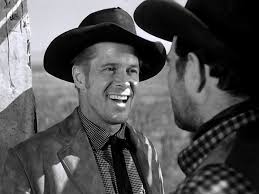
Another bad guy famous for one role in particular is JACK PALANCE. In ‘Shane’ he’s the gunman hired by a cattle baron to terrorise Wyoming homesteaders. The lank, gaunt Palance, with his cadaverous features and gloating smile, is the epitome of evil – even dogs slink away from him. This blackest of black hats – literally – lovingly pulls one glove – also black - onto his gun hand as he prepares to despatch one of these pesky ‘sod-busters’. His victim is the pathetic but still brave ‘little man’ Elisha Cook Jnr. who falls before his gun, jolting backwards and ploughing into the mud of the street in the first ‘realistic’ depiction of death in the history of the western. Even in an age of much more graphic violence this scene still has the power to shock. And viewing the victim of his murder, Palance’s tight, brittle-eyed grin stays fixed.

Jack Palance oozes evil in ‘Shane.’
Like Richard Widmark, RICHARD BOONE could also play the good guy – indeed they’re both heroic in the same movie. In ‘The Alamo’ (1960) Boone plays Sam Houston as a ‘father of Texas’, organising the defence of the new republic whilst Jim Bowie (Widmark) and others fight to the death, buying him the time to do so. Boone brought similar gravitas and authority – what one critic called ‘craggy nobility’ – to his role as the U.S. cavalry commander in the underrated ‘Thunder of Drums’ (1960.) And he was, of course, the hero of the long-running TV western series ‘Have Gun Will Travel’ as the enigmatic Paladin.
It’s a mark of Boone’s range and forcefulness as an actor that he could be equally effective as a villain. Over the years he gave a hard time to a variety of western heroes, from Kirk Douglas in ‘Man without a Star’ to John Wayne in ‘Big Jake’ and ‘The Shootist.’
Perhaps his two best villains are in films based on Elmore Leonard stories – where he shows two faces of villainy. In ‘The Tall T’ (1957) he’s an intelligent, conflicted stage robber, tortured by his own loneliness. The nearest thing to a friend he finds is ostensibly his enemy, Randolph Scott, who he holds prisoner. We catch hints of the instability that’s perhaps brought him to crime – he has a sadistic sense of humour and laughs delightedly when someone burns their fingers on a coffee pot. But he sometimes shows affection and tenderness for the woman he holds captive. At the end he’s given a choice between staying bad or reforming – I won’t spoil the ending of this outstanding film by telling you which he opts for!

Richard Boone with Randolph Scott in ‘The Tall T.’
If his villain in ‘The Tall T’ shows vulnerability and evokes some sympathy, that’s not the case in ‘Hombre’ (1967) – another example of a bad guy being bad and loving it. Boone’s swaggering Cicero Grimes exudes lusty, brutal energy, with his harsh laugh and aggressive demeanour leaving others cowed.

In ‘Hombre.’
It was a tough call singling out western bad guys from among so many worthy contenders and winnowing them down to a final eight. There’s undoubtedly some I’ve overlooked – but I had little doubt who would be in pole position, the best of the bad guys. So here he is, the very worst of the west, in my opinion:
Emerging in the 1960s, BRUCE DERN might have been the ‘son’ or ‘nephew’ of DAN DURYEA in that he had similar characteristics: His long face, whining voice and wild eyes marked him out as inherently irrational and unstable, poised  for sudden, unpredictable violence. This has kept him in work through a long and distinguished career. As he said: ‘I’ve played more freaks, psychotics and dopers than anyone.’ But he eschewed Duryea’s treacherous charm, which made him a genuinely chilling screen villain.
Although he has played in a wide range of films, he took very naturally to the western and was a staple of movies and TV series, adding his menacing presence to episodes of every show from ‘Bonanza’ to ‘Lancer’ to ‘The High Chaparral.’ He was particularly memorable as one of the homicidal sons of crazed semi-preacher Donald Pleasance in ‘Will Penny.’


Bruce Dern with Charlton Heston (having a bad day) and Donald Pleasance in 'Will Penny.'
Like the others here, Bruce is a fine actor of wide range. In the moving sci-fi fable ‘Silent Running’ he was literally the last defender of the Earth’s ecology, a voice of sanity (despite how crazy he might look) in a world lost to crass consumerism.


In ‘Silent Running.’
But that very same year – 1972 – Dern became possibly the baddest bad guy in western film or TV.
As John Wayne’s enemy in ‘The Cowboys’ Bruce commits a deed so dastardly that it dwarfs almost any other misdeed in the history of the screen western. I won’t give away what it was, in the unlikely event that anyone reading this blog hasn’t seen this excellent movie. Suffice it to say, John Wayne told Dern something like: “Oh, how they're gonna hate you for this!” – and viewers of ‘The Cowboys’ across the world proved him right.


Bruce Dern about to do the unthinkable to John Wayne in ‘The Cowboys.’
But prior to committing this blackest of crimes Bruce had already demonstrated his utter villainy in the way he terrorises the ‘cowboys’ of the title – a collection of schoolboys Wayne is forced to use on a trail drive. In one scene Dern tells one boy in chilling detail just exactly how he’ll sneak up on him in the dark and slit his throat. In another he snatches off another boy’s spectacles and lovingly crushes them between his hands, leaving only a buckled, glassless frame – it doesn’t get any badder than that!


‘The Cowboys.’
And thus Bruce Dern earns my top position in the ranks of actors who gave outstanding villain in westerns, and wins my accolade as the very worst of the west.

Feel free to disagree!