Showing posts with label Montana. Show all posts

Tuesday, 15 March 2022

AUTHOR FAVOURITES: HOLMES ON THE RANGE by STEVE HOCKENSMITH

 STEVE HOCKENSMITH has written novels that are a hybrid of western and mystery, hybrids of horror and classic novels (‘Pride and Prejudice and Zombies: Dawn of the Dreadfuls’) and a mix of mystery and magical. He’s also written short stories.

Several of Steve’s short stories have been nominated for awards in the mystery field. He won the Short Mystery Fiction Society's Derringer Award for ERIE'S LAST DAY, published in the May 2000 issue of ‘Alfred Hitchcock Mystery Magazine.’  Other short stories were finalists for the Shamus Awards and the Anthony and Barry Awards.

His short story HIRED GUNS: MULE’S GOLD was, for me, one of the highlights of the SIX GUN JUSTICE PODCAST WESTERN STORIES anthology. From my review of this anthology: ‘HIRED GUNS: MULE’S GOLD is a stark outdoors tale of prospectors searching the harsh Sonora desert for an abandoned gold mine. Meanwhile, they’re being stalked by hidden enemies. Again this features terse, cinematic prose, with some laconic humour. It reads like the gritty first chapter of a novel (or a series) which I would be very happy to read.’


Find SIX GUN JUSTICE PODCAST WESTERN STORIES here: https://www.amazon.com/Six-Gun-Justice-Western-Stories-ebook/dp/B09CMV5GMH

Like many authors I’ve featured, Steve’s favourite of his own novels is his first one: HOLMES ON THE RANGE. He says: “I think it established everything I would try to bring to my later books: offbeat but likeable protagonists, lots of humour that's hopefully funny without undercutting the stakes, and an approach to genre tropes and expectations that's both irreverent and affectionate.”

This is the first instalment of a 6-part series. It was a finalist for the Shamus and the Anthony Awards for Best First Novel.


Montana, the 1890s. Two itinerant cowboy brothers, nicknamed Big Red and Old Red, are working on a ranch when they come across a dead body, killed in a particularly grisly fashion. Old Red has become obsessed with the stories of British detective SHERLOCK HOLMES. He's determined to catch the killer using Holmes' methods. Whether he likes it or not (and mostly he doesn't), Big Red is dragged along for the wild ride as his brother tries to "deducify" his way to the truth. But standing between them and a solution to the mystery are stampedes, rustlers, and a cannibal named “Hungry Bob” stalking the range.

Though not the first fictional detective, SHERLOCK HOLMES is arguably the best known. Holmes was created by Scottish author SIR ARTHUR CONAN DOYLE (1859-1930.) Whole libraries have been devoted to analysing Holmes, so this is a very brief and not even remotely exhaustive take on a literary figure who has fascinated the world for almost 150 years. I’ve used Wikipedia for most of my information.


Sir Arthur Conan Doyle


First appearing in print in 1887's ‘A STUDY IN SCARLET’ the character's popularity became widespread with the first series of short stories in ‘The Strand Magazine,’ beginning with ‘A Scandal in Bohemia.’ in 1891. In total. Doyle wrote 4 novels and 56 short stories featuring Holmes. All but one are set between about 1880 and 1914.


Holmes as depicted in 1904

Referring to himself as a "consulting detective", Holmes is known for his proficiency with observation, deduction, forensic science and logical reasoning. Most of his adventures are narrated by his friend DOCTOR JOHN WATSON. Other re-occurring characters in the books include Holmes’ nemesis, the criminal mastermind, PROFESSOR MORIARTY.

At times Holmes smokes a pipe and wears a deerstalker hat; he is also a violin player and occasional cocaine and morphine user (both were legal in late Victorian Britain.) He lives at 221B Baker Street, London (an address that didn’t exist until the 1920s.)

Conan Doyle felt "my literary energies should not be directed too much into one channel” so in 1893 he killed off Holmes in a hand-to-fight with MORIARTY over the Reichenbach Falls in Switzerland; after a desperate struggle both men fell into the waterfall below. However, the public response, with distressed readers refusing to let Holmes die, was unprecedented. Conan Doyle received many protest letters, and one lady even began her letter to him with "You brute".

After resisting public pressure for 8 years, Conan Doyle brought Holmes back with perhaps his most famous adventure, ‘THE HOUND OF THE BASKERVILLES.’ He would sporadically write new Holmes stories until 1927. In his last years, the reader is told that Holmes has retired to a small farm on the Sussex Downs and taken up beekeeping as his primary occupation.

Tying in with HOLMES ON THE RANGE, the very first Holmes novel, ‘A STUDY IN SCARLET’ has a western element, as part of it takes place in late 19th Century Utah.

Conan Doyle repeatedly said that Holmes was inspired by the real-life figure of JOSEPH BELL, a surgeon at the Royal Infirmary of Edinburgh in Scotland, whom Conan Doyle met in 1877 and worked for. Like Holmes, Bell was noted for drawing broad conclusions from minute observations. Sir HENRY LITTLEJOHN, Chair of Medical Jurisprudence at the University of Edinburgh Medical School, is also cited as an inspiration for Holmes. Littlejohn, who was also Police Surgeon and Medical Officer of Health in Edinburgh, provided Conan Doyle with a link between medical investigation and the detection of crime.


Joseph Bell (1837-1911)

By the 1990s there were already over 25,000 stage adaptations, films, television productions and publications – including spin-off novels - featuring the detective. ‘Guinness World Records’ lists him as the most portrayed human literary character in film and TV history, having appeared on screen 254 times as of 2012. Many actors have also portrayed Sherlock Holmes in radio dramas and on stage.

The following have all had a crack at Holmes in one medium or another: Tom Baker, John Cleese, Benedict Cumberbatch, Robert Downey Jr., John Gielgud, Stewart Granger, Robert Hardy, Charlton Heston, Boris Karloff, Christopher Lee, Raymond Massey, Ian McKellen, Roger Moore, John Neville, Leonard Nimoy, Christopher Plummer, Robert Powell, Ian Richardson, Robert Stephens, Orson Welles and Nicol Williamson.

I particularly like portrayals by:

BASIL RATHBONE, in a series of 30s and 40s films. Here Doctor Watson is portrayed by NIGEL BRUCE as a bumbling comic foil (although he’s nothing like that in the books.)


Nigel Bruce and Basil Rathbone

PETER CUSHING in ‘THE HOUND OF THE BASKERVILLES’ (1959) with ANDRÉ MORELL as Watson. (Cushing also portrayed Holmes in a TV series.)


André Morell and Peter Cushing

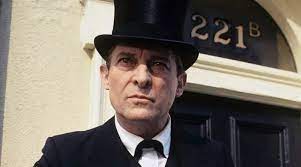
And JEREMY BRETT as Holmes in a British TV series that ran from 1984 to 1994.
Reviews of HOLMES ON THE RANGE:

"Delightfully offbeat." ‘Entertainment Weekly

"Just when it seemed as if there were no more literary riches to be wrung from Sherlock Holmes, along comes Steve Hockensmith's inspired debut novel...The star of this tale is a fresh narrator's voice that whoops and hollers, dazzling the reader with colorful language, vivid images and hilarious asides. Sherlock Holmes in a Stetson turns out to be a dandy idea." ‘The Boston Globe’

"Sherlockians, Western fans and mystery lovers who enjoy their whodunits leavened with humor should all be delighted by Hockensmith's captivating debut." ‘Publishers Weekly

 "HOLMES ON THE RANGE is a wonderful debut novel!’


Find HOLMES ON THE RANGE here: https://www.amazon.com/Holmes-on-the-Range-Mysteries-6-book-series/dp/B074CGRZ68?ref=dbs_m_mng_rwt_0000_ext

Wednesday, 10 October 2018

AUTHOR FAVOURITES: HIGH VALLEY MANHUNT by B. S. DUNN (BRENT TOWNS)


Brent Towns (who also writes as B. S. Dunn, Jake Henry, and Sam Clancy) tells me a favourite of his novels is the first LARAMIE DAVIS book, HIGH VALLEY MANHUNT (credited to B.S. Dunn) ‘because I felt a great sense of achievement’ with it.

When ageing gunfighter Laramie Davis enters a Montana town all he wants is a hot meal. Instead he finds himself in a deadly shoot out with a town lawman, then pursued by the law man’s kin. On top of that he tangles with a gang of outlaws and hostile Blackfeet Indians seeking revenge.

I thought I’d take a brief look at the history of the Blackfoot Indians.

They consist of four bands. The Siksika (‘Blackfoot’), the Kainai or Kainah (‘Blood’) and the Northern Piegan (or 'Poor Robes') reside in Alberta and Saskatchewan, Canada; the Southern Piegan or Pikuni are located in Montana in the United States. All speak one of the Algonquian languages. The unrelated Sarcee became merged into the Blackfoot Confederacy and, (for a time) the Gros Ventre. The Gros Ventre call themselves the ‘white clay people.’ The French called them Gros Ventres (‘fat bellies,') misinterpreting a sign language gesture for waterfall.

The name Blackfoot is said to have come from the color of the soles of their moccasins, typically dyed or painted black. One legend claimed that tradition arose after some Blackfeet blackened the soles of their moccasins by walking through the ashes of a prairie fire.
The Blackfoot had adopted the use of the horse by 1730. The Blackfoot called horses ‘elk dogs.’ They became buffalo hunters and established themselves as one of the most powerful and warlike tribes on the Plains by the late 18th century, earning themselves the name ‘The Lords of the Plains’.
Canadian traders established friendly trading relations with the Blackfoot from 1754. But, in tragic contrast, relations between the Blackfoot and the Americans soured almost from their first encounter.
In 1806 members of the Lewis and Clark expedition encountered a group of young Blackfoot warriors in Montana. The group camped together that night, and at dawn there was a scuffle as it was discovered that the Blackfoot were trying to steal guns and run off horses while the Americans slept. In the ensuing struggle, one warrior was fatally stabbed and another shot by MERIWETHER LEWIS himself, and presumed killed.
This set off decades of conflict between Blackfeet and Americans. They were bitter enemies of American ‘mountain men’ trapping their country. In 1809 they captured JOHN COLTER and allowed him to run for his life. Colter survived after stumbling into what later became Yellowstone National Park. (An incredible adventure that deserves a blog of its own.)
Despite these hostilities, around 1840 acclaimed painters KARL BODMER and GEORGE CATLIN were both able to paint and draw the Blackfoot.


Painting by Karl Bodmer
In 1837 Blackfoot resistance was much weakened when smallpox struck them, killing an estimated 6,000. In 1851 they were restricted to land assigned to them by the Fort Laramie Treaty. When gold strikes brought thousands of settlers to Montana from 1862 onwards the Blackfoot mounted small-scale resistance.
The most notable action in subsequent hostilities was the Marias River Massacre when one of their villages was destroyed by the US Army on January 23, 1870. Controversy surrounds this incident but evidence suggests this was a peaceful camp attacked by mistake and that of 173 Blackfeet killed, only 15 were warriors.


BUFFALO BULLS BACK by George Catlin
Blackfoot resistance was fading. When the Sioux were engaged in fighting the United States Army in 1876, they sent runners into Blackfoot territory, urging them to join the fight. CROWFOOT, one of the most influential Blackfoot chiefs, dismissed the Sioux messengers.
In Canada the Blackfeet largely stayed out of conflicts with the North West Mounted police, and the two serious Indian rebellions of 1869 and 1885. When news of continued Blackfoot neutrality reached the Canadian government, LORD LANDSDOWNE, the governor general, expressed his thanks to Crowfoot on behalf of QUEEN VICTORIA. The cabinet of the current Prime Minister even gave Crowfoot a round of applause.


Blackfoot medicine man by George Catlin
Nowadays there are approximately 32,000 Blackfeet living in the U.S.A. and Canada.

The Montana setting and ageing hero aspect of HIGH VALLEY MANHUNT brought to mind the classic 1967 western ‘Will Penny’ with CHARLTON HESTON. 


Meanwhile the small town run by a corrupt family who provide judge and sheriff etc. reminded me of ‘Buchanan Rides Alone’ with RANDOLPH SCOTT


Reviews of HIGH VALLEY MANHUNT:

‘The plot was well thought-out and original, the writing style was sharp and entertaining, and the hero was compelling.’

‘I love the pace of Dunn's writing. He seems to balance the characters, the scenery and the action perfectly.’

‘A great fast-paced read. Strong characters people this action-packed western.’ 

https://www.amazon.com/High-Valley-Manhunt-Laramie-Davis-ebook/dp/B00VHFPVJ2/ref=sr_1_1_twi_kin_1?s=books&ie=UTF8&qid=1538911066&sr=1-1

and https://www.amazon.co.uk/High-Valley-Manhunt-Laramie-Davis-ebook/dp/B00VHFPVJ2/ref=tmm_kin_swatch_0?_encoding=UTF8&qid=&sr=

Wednesday, 3 October 2018

AUTHOR FAVOURITES: VALLEY OF THUNDER by SAM CLANCY (BRENT TOWNS)

Brent Towns (who also writes as B. S. Dunn, Jake Henry, and Sam Clancy) tells me an overall favourite of his novels is VALLEY OF THUNDER by Sam Clancy. ‘I really enjoy writing about Josh Ford.’

Marshal Josh Ford investigates a wagon train that has disappeared in the wilderness of Montana and the Pacific North West. He comes up against a brutal autocrat who rules the area with his private army, rather like the historical Henry Plummer.

WILLIAM HENRY HANDY PLUMMER was born in 1832 in Addison, Maine. In 1852, aged 19, he headed west to the California gold fields. In 1856, he was elected sheriff and city manager in Nevada City, California. His tenure as sheriff ended in controversy a year later when he shot and killed John Vedder. Convicted of second-degree murder, he served time in San Quentin Prison but was granted a pardon due to poor health as he was suffering from tuberculosis.


Plummer left California and drifted across the Pacific Northwest. In 1862 he arrived in Bannack, Montana, where gold had been recently discovered. Despite (or perhaps because of) having killed several men in gun duels he was elected sheriff of Bannack.
Between October and December 1863, the rate of robberies and murders in the area increased significantly. Local citizens formed the Vigilance Committee of Alder Gulch in Virginia City, Montana. Between January 4 and February 3, 1864, the vigilantes arrested and summarily executed at least 20 alleged ‘road agents.’ One was ‘Erastus Red’ Yeager. Before his hanging, Yeager made a complete confession, naming Henry Plummer as leader of the gang, ironically nicknamed ‘The Innocents.’ At their peak it’s claimed ‘The Innocents’ numbered almost 200 men. One of their specialities was to waylay stages that had been marked with chalk by Plummer’s informants, indicating they carried gold.
Plummer was arrested by the vigilantes on the morning of January 10, 1864. Standing before his captors, Plummer asked them, ‘You wouldn’t hang your own sheriff, would you?’
They would and did – the same day.
Plummer was given a posthumous trial in 1993 which led to a mistrial. The jury was split 6-6.
I’d expected Plummer to feature quite a lot in western movies and TV but I could only find him being portrayed by TOM McKEE in an episode of ‘Tales of Wells Fargo’ and JOHN DEHNER in an episode of ‘Stories of the Century.’


John Dehner as Henry Plummer

The Nez Perce Indians also feature in VALLEY OF THUNDER. These remarkable people, and particularly the tragic war they fought against the white man in 1877, deserve at least one separate blog.


The wagon train aspect reminded me of movies like MEEKS CUTOFF


and one of my favourite westerns, John Ford’s lyrical masterpiece ‘WAGONMASTER.’


Ward Bond, Jane Darwell and Russell Simpson in ‘Wagonmaster

VALLEY OF THUNDER reviews:
‘A great read.’

‘Amazing.'

‘The descriptive writing is superb and I saw each landscape and action sequence in full technicolour as though it were playing out on a cinema screen. There was no fat in this story, no padding. It promised sweeping adventure and it delivered in spades.’

‘A great adventure yarn.’

https://www.amazon.com/Valley-Thunder-Black-Horse-Western-ebook/dp/B01N9XDKWL/ref=sr_1_1?s=books&ie=UTF8&qid=1492581090&sr=1-1&keywords=valley+of+thunder+sam+clancy

and https://www.amazon.co.uk/Valley-Thunder-Black-Horse-Western-ebook/dp/B01N9XDKWL/ref=tmm_kin_swatch_0?_encoding=UTF8&qid=&sr=

Wednesday, 21 March 2018

AUTHOR FAVOURITES: THE POACHER’S DAUGHTER by MICHAEL ZIMMER


Michael Zimmer tells me he has 4 favourites of his own westerns! One, THE POACHER’S DAUGHTER, won the Western Heritage Wrangler Award.

Montana 1885. After young Rose Edwards is widowed by vigilantes who hang her husband for an alleged theft, she turns outlaw. Later she finds herself the reluctant hero of the local Native American population, aiding them in their struggle against encroaching settlement. 

Clashes between Montana cattlemen and settlers on one hand, and outlaws and Indians on the other, form the background to Michael’s tale. Michael is rightly proud of the authenticity of his work.
In 1884 cattlemen in Montana organised against rustlers operating in the Musselshell River region. Led by prominent rancher GRANVILLE STUART, this group of vigilantes, known as ‘Stuart's Stranglers’, were responsible for the deaths of at least 20 thieves in July 1884, by hanging, shootings or fire.

Montana rancher Granville Stuart
The novel is dedicated to the free-spirited and independent women of the Old West.
There were a number of female outlaws in western history. They include ROSE DUNN, the ‘Rose of the Cimarron,’ ‘Cattle Annie’ and ‘Little Britches’ (ANNIE MCDOUGAL and JENNIE STEVENS) PEARL HART, FLORENCE QUICK and ‘Cattle Kate’ (ELLA WATSON) who was lynched by Wyoming vigilantes in 1889.

Probably most famous however is BELLE STARR, (1848-1889) nicknamed ‘The Queen of Bandits.’ She – alongside the James-Younger Gang, the Doolin-Dalton Gang and others - was a product of the combination of two anarchic elements: the American Civil War as waged by guerrilla bands in and around Missouri, and the lawlessness of the adjoining Indian Territory (now Oklahoma) which became a refuge for outlaws, many of them disaffected confederates, from the 1860s to the 1890s.  


Belle Starr was a farm girl, born MYRA MAYBELLE SHIRLEY in Missouri, whose brother was killed in the Civil War. She knew the James-Younger Gang, although a story that the father of her daughter was COLE YOUNGER was disputed by Younger himself.

She married at least three outlaws: JIM REED, SAM STARR and JIM JULY STARR - all three of whom were killed in gunfights. The Starrs' were members of a notorious Cherokee outlaw clan operating in Indian Territory. Although Belle occasionally donned male attire and took part in raids, she was mostly the 'brains' behind a lot of their criminal activities - organising, planning and fencing for the rustlers, horse thieves and bootleggers she worked with, as well as harbouring them from the law.

In 1883 she was arrested by the famed black lawman BASS REEVES and brought before 'hanging judge' JUDGE ISAAC PARKER. Charged with horse theft she served 9 months in prison and was deemed a model prisoner.

On February 3, 1889, she was riding home near Eufaula, Oklahoma when she was ambushed and killed. Her death resulted from shotgun wounds to the back, neck, shoulder and face. Suspects range from her husband, Jim July Starr, to her two children, as well as neighbour EDGAR J. WATSON. It was rumoured Belle knew Watson was an escaped murderer with a price on his head and he killed her to shut her up. But the murder remains officially 'unsolved.'

Many of the actresses who specialised in playing 'feisty' women in western TV shows and films have portrayed Belle, among them Isabel Jewell, Jane Russell, Marie Windsor, Jeanne Cooper and Jean Willes.


Marie Windsor as Belle

Rather more unlikely actresses in the role include Gene Tierney,


The real Belle (left) and Gene Tierney

Elizabeth Montgomery and - perhaps oddest of all - Italian actress Elsa Martinelli!


Elsa Martinelli as Belle

The setting of the Montana cattle country reminded me of books/movies like 'These Thousand Hills' and 'The Missouri Breaks.'


These Thousand Hills’ (1959)

Reviews of THE POACHER’S DAUGHTER:

‘It detonated like dynamite in my hands’

‘A wonderfully endearing heroine with a gentle heart and steel in her spine’

‘Zimmer ratchets up the tension to piano wire tautness’

‘One of the best westerns I have ever read.’


Wednesday, 9 August 2017

AUTHOR FAVOURITES: THE LONG TRAIL by BRAD DENNISON


It’s becoming the norm when I ask authors which is the favourite of their books for them to pick 2! (It’s a tough call, I know, like asking which is your favourite pet, your cat or your dog.) Brad Dennison does have a personal favourite of his westerns, which I’ll post about shortly. However he tells me it’s really best to start with THE LONG TRAIL, the first of his McCABE series. Brad says: ‘The McCabes aren't really stand-alone novels. There are story arcs that weave their way through more than one novel.’

THE LONG TRAIL begins with Dusty, who grew up on the frontier never knowing who his parents were. Coming into young manhood he decides to find them. His quest takes him first to Nevada (where he encounters a woman in danger at a lonely stage station, resulting in a cracking shoot-out in Chapter 1.) Dusty discovers his father is still alive – former gun fighter Johnny McCabe, now a rancher in Montana. Arriving at his father’s ranch, Dusty has to adapt to his new family - not only his father, but his step-brother and sister. And while he’s about it raiders strike - men Dusty knows all too well from his childhood.
Here’s a real way-station in Nevada


and another at Jackson Hole, Wyoming. 


And here’s two prominent Montana cattle ranchers:
GRANVILLE STUART (1834-1918) a rancher (and also author) who started cattle ranching in Montana as early as 1857. 


And German-born CONRAD KOHRS (1835-1920) who started ranching in Montana in 1866 but suffered mixed fortunes: ‘I guess I’ve been broke oftener than any man in Montana.’


The theme of the prodigal son/ sons finding out his/their absent father is/was a big rancher naturally made me of 2 TV Western series: THE BIG VALLEY


 Lee Majors in 'THE BIG VALLEY'

and LANCER.


The Montana ranch location also reminded me of THESE THOUSAND HILLS, a film based on a novel by A. B. Guthrie Jr., a writer who both Brad and I admire.


Finally the woman in danger at the remote way-station brought to mind Karen Steele in the Randolph Scott western RIDE LONESOME (1959.)


The last time I looked THE LONG TRAIL has garnered 110 5 star reviews!
Reviews:
‘A classic western.’
‘The best western I’ve read in a long time.’
‘Found myself sitting up late at night not able to put it down.’
'In the vein of the late Louis L'Amour.'
'Great book, never goes stale.'
'Some good characters and some very fine writing.'